What Does Your Voice Say About Your Stress Levels?

You’re in the middle of a high-stakes investor update or fixing a sudden product crisis, feeling totally in control. But listen closely to your voice for a second: you’re talking faster, your tone sounds tight, and you’re catching your breath mid-sentence.
Most founders and high performers dismiss these subtle changes as simple everyday adrenaline or normal meeting energy. In reality, it is raw, unfiltered bio-feedback. Your vocal tract is directly wired into your central nervous system, meaning your voice acts as a real-time loudspeaker for early physiological strain—long before your brain consciously registers that you are hitting a wall or heading toward burnout.
When high-stakes workplace pressure hits, your body automatically triggers a fight-or-flight response behind the scenes. Some of these responses include:
When pressure hits, your body automatically triggers a stress response behind the scenes:
Muscle Tightening: Stress hormones flood your system, causing the tiny muscles around your vocal cords to contract and subtly raising your voice pitch.
Micro-Tremors: That adrenaline surge creates tiny, high-frequency vibrations in your throat that human ears can't hear, but the physical strain is real.
Breathing Changes: Shallow breathing alters your speech rhythm, making you talk faster to make up for less airflow.
You might look completely calm on screen, but biologically, your battery is running down to critical levels.
How Your Brain Uses Frequencies
To understand how to fix this, it helps to look at how your brain actually works. Your brain is made up of billions of tiny brain cells called neurons. These cells communicate with each other using tiny pulses of electricity.
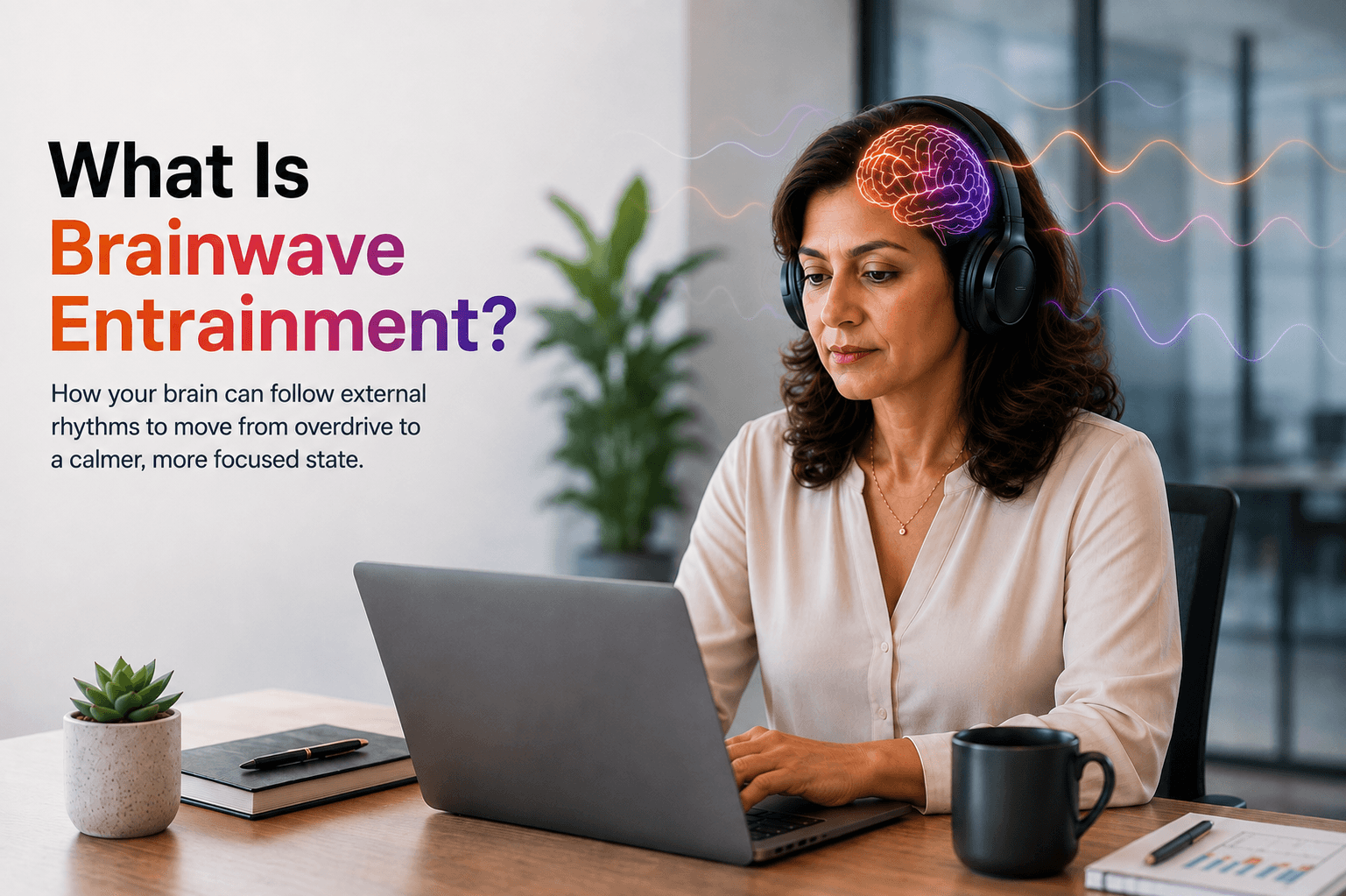
Everything in nature has a frequency, and your brain is no different. When groups of neurons fire together, they create rhythmic electrical patterns known as brainwaves.
Your brain has an innate behavior: it automatically tries to match and follow outside frequencies, whether they come from sound waves or flashes of light. If an outside sound plays at a specific frequency—say 5 Hz—your brain's electrical pulses will naturally shift to match that same 5 Hz pace.
Different frequencies activate different parts of your brain and control how you perform:
Beta Frequency (High Speed): Active during fast thinking and intense problem-solving. Running at this high speed for too long causes stress and mental overload.
Alpha Frequency (Steady Speed): The sweet spot for smooth, calm focus and effortless work.
Theta Frequency (Slow Speed): The relaxed state needed for deep rest, emotional balance, and recovery.
Why Stress Drains Your Mind (And Why Manual Audio Fails)
When you are under heavy stress, your brain gets stuck in ultra-fast Beta mode. In this state, you lose your cognitive abilities—your focus drops, your memory slows down, and making smart decisions costs twice as much energy.
Many people try listening to targeted sound frequencies or binaural beats to calm down. But when you are already stressed, guessing which sound frequency to play, hunting for audio tracks, or taking a 20-minute break feels like extra work. Most people simply don't have the time or energy to manage it, so they give up.
How NextYou Fixes This Automatically
This is where NextYou: Burnout Recovery AI takes away all the guesswork.
Instead of asking you to figure out what your brain needs, NextYou uses its Sound Check feature alongside an intelligent AI agent named Nuo to handle the process for you.
Smart Voice Analysis: Simply speak a quick phrase into your microphone—like "Ready for the next call." NextYou instantly checks your vocal tone and muscle tension. It analyzes sound wave patterns only, ensuring zero words are ever recorded or saved.
AI Personalization: Nuo reads your voice stress signals and knows exact tailored frequencies your brain needs at that precise moment. There is no guesswork involved.
Zero-Touch Audio Delivery: The moment vocal tension spikes, Nuo automatically streams targeted sound frequencies straight to your headphones while you keep working.
Your brain naturally follows the sound frequency, downshifting your stress levels and restoring your mental clarity while you stay focused on your day.
Download the NextYou App on Google Play: https://play.google.com/store/apps/details?id=app.nextyou.android&hl=en_IN
You’re in the middle of a high-stakes investor update or fixing a sudden product crisis, feeling totally in control. But listen closely to your voice for a second: you’re talking faster, your tone sounds tight, and you’re catching your breath mid-sentence.
Most founders and high performers dismiss these subtle changes as simple everyday adrenaline or normal meeting energy. In reality, it is raw, unfiltered bio-feedback. Your vocal tract is directly wired into your central nervous system, meaning your voice acts as a real-time loudspeaker for early physiological strain—long before your brain consciously registers that you are hitting a wall or heading toward burnout.
When high-stakes workplace pressure hits, your body automatically triggers a fight-or-flight response behind the scenes. Some of these responses include:
When pressure hits, your body automatically triggers a stress response behind the scenes:
Muscle Tightening: Stress hormones flood your system, causing the tiny muscles around your vocal cords to contract and subtly raising your voice pitch.
Micro-Tremors: That adrenaline surge creates tiny, high-frequency vibrations in your throat that human ears can't hear, but the physical strain is real.
Breathing Changes: Shallow breathing alters your speech rhythm, making you talk faster to make up for less airflow.
You might look completely calm on screen, but biologically, your battery is running down to critical levels.
How Your Brain Uses Frequencies
To understand how to fix this, it helps to look at how your brain actually works. Your brain is made up of billions of tiny brain cells called neurons. These cells communicate with each other using tiny pulses of electricity.
Everything in nature has a frequency, and your brain is no different. When groups of neurons fire together, they create rhythmic electrical patterns known as brainwaves.
Your brain has an innate behavior: it automatically tries to match and follow outside frequencies, whether they come from sound waves or flashes of light. If an outside sound plays at a specific frequency—say 5 Hz—your brain's electrical pulses will naturally shift to match that same 5 Hz pace.
Different frequencies activate different parts of your brain and control how you perform:
Beta Frequency (High Speed): Active during fast thinking and intense problem-solving. Running at this high speed for too long causes stress and mental overload.
Alpha Frequency (Steady Speed): The sweet spot for smooth, calm focus and effortless work.
Theta Frequency (Slow Speed): The relaxed state needed for deep rest, emotional balance, and recovery.
Why Stress Drains Your Mind (And Why Manual Audio Fails)
When you are under heavy stress, your brain gets stuck in ultra-fast Beta mode. In this state, you lose your cognitive abilities—your focus drops, your memory slows down, and making smart decisions costs twice as much energy.
Many people try listening to targeted sound frequencies or binaural beats to calm down. But when you are already stressed, guessing which sound frequency to play, hunting for audio tracks, or taking a 20-minute break feels like extra work. Most people simply don't have the time or energy to manage it, so they give up.
How NextYou Fixes This Automatically
This is where NextYou: Burnout Recovery AI takes away all the guesswork.
Instead of asking you to figure out what your brain needs, NextYou uses its Sound Check feature alongside an intelligent AI agent named Nuo to handle the process for you.
Smart Voice Analysis: Simply speak a quick phrase into your microphone—like "Ready for the next call." NextYou instantly checks your vocal tone and muscle tension. It analyzes sound wave patterns only, ensuring zero words are ever recorded or saved.
AI Personalization: Nuo reads your voice stress signals and knows exact tailored frequencies your brain needs at that precise moment. There is no guesswork involved.
Zero-Touch Audio Delivery: The moment vocal tension spikes, Nuo automatically streams targeted sound frequencies straight to your headphones while you keep working.
Your brain naturally follows the sound frequency, downshifting your stress levels and restoring your mental clarity while you stay focused on your day.
Download the NextYou App on Google Play: https://play.google.com/store/apps/details?id=app.nextyou.android&hl=en_IN